Mission Log

Follow each test while it happens. Every mission starts with what we expect and what we do not know. The log records each step, from us and from the observatories and labs whose data decides the test. At the end, we count what we learned.

Draft for review, 17 September 2026. This page is not linked from the site. The entries are real; the starting points were written this week from each mission's current record.

How a mission is followed

A result is one step in a mission, not its score. What counts is what we know at the end that we did not know at the start, including what we learned about ourselves.

1 · At registration

Starting point

What we expect and why, what we do not know yet, and the assumptions we are making.

2 · During the mission

Mission Log

Every change, review and outside data release, with the reason. Entries are added, never edited.

3 · At the end

Debrief

What we learned about the question, the data and methods, our process, and ourselves, and what carries forward.

What we have learned so far

Counted from the log below.

18
Log entries
4
From observatories and labs
5
Changes explained
1
Entries after the deciding data
2
About the question
2
About the data and methods
2
About our process
1
About ourselves

The log

Newest first. Ic² entries are our changes. Outside entries come from the teams whose data decides a test. Each one says whether it came before or after the deciding data, because a change after the data deserves a closer look.

17 September 2026
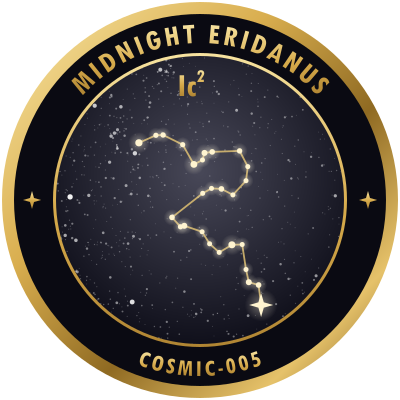
Midnight Eridanus COSMIC-005 Ic² Amended Before the data

Version 1.1 of the record was deposited on Zenodo. It lists DR2 Results IV, fixes the 3.1σ baseline and the choice of CMB data, and gives 2027 as the expected release. The claim, the measure and the outcome boundaries are word for word the same, and version 1 stays available.

Why it matters: The review found gaps that were ours to close before the data, and closing them in public shows exactly what changed.

Record →
17 September 2026
Missions Ic² Named Before the data

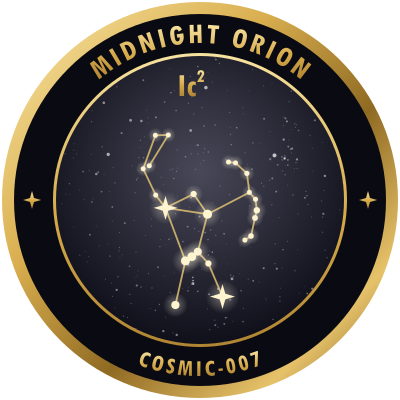
The first eleven tests received mission names: the program's color and one of the 88 constellations, drawn from real star positions. COSMIC-007 is named for Orion because its predicted axis points there. Names are kept for good, whatever the result.

Why it matters: A name gives followers something to follow from start to finish.

17 September 2026
Framework Ic² Published Before the data

Standard model comparison panels were added to COSMIC-005 and COSMIC-007, showing what ΛCDM predicts beside what the framework predicts.

Why it matters: A follower cannot judge a prediction without knowing what the alternative predicts.

16 September 2026
COSMIC-003 Ic² Reviewed After the data

A literature check on JWST's early massive galaxies found that a factor-of-10 claim in our audit was not supported by its source. Most current work explains much of the excess with bursty star formation. A caveat was added to the site.

Why it matters: COSMIC-003 was written after JWST's first results, so it was never a test. What we say about it still has to be accurate.

Learned, about ourselves: We repeated a number without reading the paper it came from. Numbers are now traced to the source before they are published.
16 September 2026
Midnight Eridanus COSMIC-005 Outside Date moved Before the data

Fermilab says the first results from the full five-year survey are expected in 2027. The site had said from 1 December 2026. The date was changed on every page.

Why it matters: The deciding date belongs to the observatory, not to us.

Learned, about the data and methods: We had published a date the observatory never gave. Dates now come from the collaboration's own statements.
Source →
16 September 2026
Midnight Eridanus COSMIC-005 Ic² Reviewed Before the data

The pre-test review found that the record did not list DR2 Results IV, public six weeks before the deposit. It fixed the 3.1σ baseline and the choice of CMB data in advance. The prediction and its boundaries did not change. Version 1.1 of the record is recommended.

Why it matters: A review before the data may complete a record, but it must never move the line between outcomes.

Learned, about our process: Our search before depositing missed a relevant DESI paper. A literature check now comes before every registration, not only before the result.
Record →
15 September 2026
Framework Ic² Reviewed Before the data

A claim audit compared the framework's public claims against current literature and listed what to watch.

Why it matters: Claims age. The audit sets a review date for each one.

Learned, about our process: A claim needs a date on which it is checked again, not only a date on which it was made.
15 September 2026
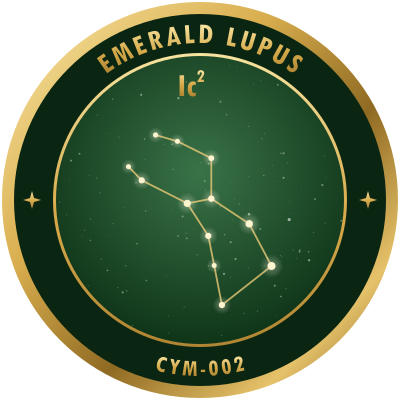
Emerald Lupus CYM-002 Ic² Amended Before the data

Preprint version 1.1 was published on Zenodo with the corrected predictions and media table.

Why it matters: The public record should match what we now expect, and the earlier version stays available beside it.

Record →
15 September 2026
Emerald Lupus CYM-002 Ic² Amended Before the data

A model of the sound field inside the sphere showed that particles do not gather at the pressure node. Predictions 1 to 4 were corrected before any experiment: the shell's radius depends on the medium, and the next shells are not harmonics.

Why it matters: The original predictions rested on an assumption the physics does not support. Correcting them before any data keeps the test honest.

Learned, about the question: Particles collect at different radii depending on the medium: about 0.59 of the radius for water mist, 0.46 for soap bubbles and 0.68 for polystyrene in water. The first resonance of a rigid sphere is not a shell at all.
Record →
15 September 2026
CYM-003 Ic² Retired Before the data

CYM-003, the crop formation comparison, was retired before any test. It kept its place on the results page as a record.

Why it matters: It assumed Chladni figures are slices of a three-dimensional sound field. They map how a flat plate vibrates, so the comparison had no physical basis.

Learned, about the question: Chladni figures are maps of a vibrating plate, not cross-sections of a three-dimensional field.
12 September 2026
Midnight Orion COSMIC-007 Ic² Registered Before the data

COSMIC-007 was deposited on Zenodo. The decision rule adds a 3σ threshold and the specific axis to what the website first published, which makes it harder to satisfy.

Why it matters: A timestamped record, with the rule tightened and nothing relaxed.

Record →
12 September 2026
Midnight Eridanus COSMIC-005 Ic² Registered Before the data

COSMIC-005 was deposited on Zenodo with its measure fixed in advance: DESI's significance for evolving dark energy, from BAO plus CMB without supernovae, must rise above about 3.1σ, with w₀ above −1 and wₐ below 0.

Why it matters: The framework's earlier dark energy claim was written after DESI's first results. This is its first formal prediction made before the data.

Record →
30 July 2026
Midnight Eridanus COSMIC-005 Outside New result Before the data

DESI released DR2 Results IV, Lyman-alpha measurements from the same three-year data. DESI said they agree with the standard model and that the hints of evolving dark energy may fade, or that a more complex model may be needed.

Why it matters: It does not decide the mission, which waits for the five-year analysis, but it makes a partial or falsified outcome more likely.

Learned, about the data and methods: The three-year data does not point one way. Different measurements from the same survey pull toward and away from evolving dark energy.
Source →
30 June 2026
Midnight Orion COSMIC-007 Outside Data milestone Before the data

The Vera C. Rubin Observatory began its ten-year Legacy Survey of Space and Time. The first full data release is expected in mid-2028.

Why it matters: The survey that decides this mission started after the axis was published.

By 28 May 2026
Midnight Orion COSMIC-007 Ic² Published Before the data

The predicted axis, (l, b) ≈ (210°, −20°), was on the website by this date, the earliest the site's public history records.

Why it matters: The direction is the hardest part of the prediction to meet by chance, so its date matters.

15 April 2026
Midnight Eridanus COSMIC-005 Outside Data milestone Before the data

DESI completed its planned five-year survey. The cosmology analysis of that dataset had not been released.

Why it matters: The deciding data now exists but is not public, so a prediction made now is still a prediction.

Source →
February 2026
Emerald Lupus CYM-002 Ic² Registered Before the data

The microgravity acoustic experiment and its predictions were documented, with preprint version 1.0 on Zenodo. CYM-003, a crop formation comparison, was documented at the same time.

Why it matters: Predictions are written down before any chamber is built or flown.

Record →
31 July 2025
Framework Ic² Published Before the data

The COSMIC Framework reference paper was deposited on Zenodo.

Why it matters: It fixes the framework's public form, so later predictions can be dated against it.

Record →

Starting points

What each mission expects, does not know and assumes. New missions will write this on the day they are registered.

Midnight Eridanus
COSMIC-005 · DESI five-year results, expected 2027

We expect

DESI's five-year analysis shows evolving dark energy more strongly than the three-year data did, in the same direction.

We do not know yet

  • When DESI will release the five-year analysis.
  • Whether the three-year hints were real or will fade.
  • How much of the earlier signal came from supernova data, which this test leaves out.

We are assuming

  • That BAO plus CMB without supernovae is a fair single measure.
  • That DESI reports a result in the same form it used for the three-year data.

Next open step

Next pre-test review once DESI announces a date

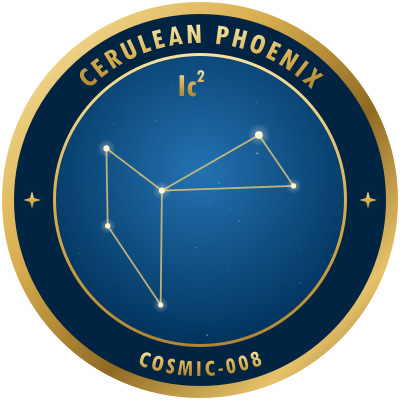
Cerulean Phoenix
COSMIC-008 · Simons Observatory; no release date announced

We expect

CMB polarization shows a non-random pattern at an angular scale derived from the framework's information-density equations.

We do not know yet

  • The numeric angular scale, which the public record does not yet state.
  • When the Simons Observatory will release the data; no date has been announced.

We are assuming

  • That the scale can be derived before the data is seen.
  • That a pattern at that scale could be told apart from known foregrounds.

Next open step

State the scale; check the dates on the card; deposit

Midnight Orion
COSMIC-007 · Rubin DR1, mid-2028

We expect

Galaxy distributions beyond about 100 megaparsecs are not the same in every direction, and the preferred axis points toward (l, b) ≈ (210°, −20°).

We do not know yet

  • Whether Rubin's first data release will control dust and selection effects well enough to test an axis.
  • Whether any anisotropy found will point in the predicted direction.

We are assuming

  • That the collaboration's own systematics treatment is the right baseline.
  • That the axis identified before the survey is the one to test.

Next open step

Pre-test review before DR1

Emerald Lupus
CYM-002 · Parabolic flight, after CYM-001

We expect

In microgravity, particles in a driven sphere gather in three-dimensional shells and clusters set by the chamber's resonances, at radii that depend on the medium.

We do not know yet

  • Whether the ground prototype (CYM-001) will behave as modeled.
  • Funding for parabolic flights, estimated at $50,000 to $150,000.
  • How well a real chamber matches the rigid-sphere model.

We are assuming

  • That 22 seconds of microgravity per arc is long enough for patterns to form.
  • That the transducers drive the intended modes and not their neighbors.

Next open step

Pre-register flight geometries before flight

Citrine Monoceros
COG-AUG I · Internal study, testing from Feb 2027

We expect

Four effects on how people encode and remember information, beginning with a drop of at least 15% in comprehension when text asks for more than two or three working-memory chunks at once.

We do not know yet

  • How large the other three effects will be.
  • Who the participants will be and how many.

We are assuming

  • That comprehension can be measured the same way across presentation formats.
  • That the validation card and the schedule describe the same study; their wording differs today.

Next open step

Align card and schedule wording; numbers for 1.2 to 1.4

Aqua Delphinus
NBI-005 · Performance testing, from Apr 2027

We expect

The performance gap between biological and non-biological intelligence is structured by task type, because biological minds carry survival overhead that AI systems do not.

We do not know yet

  • Which task set separates survival overhead from other differences.
  • How to measure that overhead directly.

We are assuming

  • That the gap can be compared fairly across very different systems.
  • That task types can be ranked by survival load before testing.

Next open step

State the predicted pattern in numbers

Crimson Centaurus
COSMIC-SD-001 · LHCb comparison, from May 2027

We expect

CP-violating particle processes release heat beyond momentum-transfer predictions, in proportion to the information erased.

We do not know yet

  • How big the effect would be in measurable units.
  • Whether LHCb, ATLAS or CMS data can resolve heat at that level.

We are assuming

  • That Landauer's principle applies at particle scales.
  • That existing detector data can serve as the test.

Next open step

Size of the effect; which data decides

Crimson Draco
COSMIC-SD-002 · Published angles, once the function is fixed

We expect

The quark mixing angles and CP phase minimize an information-theoretic cost function.

We do not know yet

  • The cost function itself, which is not yet derived.

We are assuming

  • That the function can be fixed before comparing it with the angles, which are already public.

Next open step

Deposit the function before the comparison

Magenta Aquila
COSMIC-SD-003 · Lattice QCD from Apr 2027; EIC in the 2030s

We expect

Entanglement entropy at the confinement boundary scales with the framework's information-density parameter.

We do not know yet

  • The value of the parameter for this comparison.
  • Whether lattice calculations reach the needed precision before the Electron-Ion Collider runs in the 2030s.

We are assuming

  • That lattice results are a fair stand-in until collider data exists.

Next open step

State the predicted scaling in numbers

Magenta Sextans
COSMIC-SD-004 · Existing RHIC and ALICE data, analysis from Feb 2027

We expect

At the quark-hadron crossover, entanglement entropy drops in a way that thermal predictions do not produce.

We do not know yet

  • Whether existing RHIC and ALICE data can show an entropy drop at all.
  • What size of drop counts as distinct.

We are assuming

  • That data already collected can serve as a test of a prediction written after it was collected.

Next open step

Fix the analysis and threshold before looking

Citrine Telescopium
COSMIC-013 · Internal testing, from Apr 2027

We expect

Autophagy and synaptic pruning release heat consistent with Landauer's limit, about 10⁻²¹ joules per bit, detectable above baseline.

We do not know yet

  • Whether any calorimeter can detect heat at that level in living cells.
  • How to count the bits erased.

We are assuming

  • That the heat can be separated from ordinary metabolism.

Next open step

State the detection threshold

Verification matrix

This checks how each test is set up, not how it turns out. A gap here is the next thing to fix.

MissionWritten before the dataTimestamped recordNumeric thresholdReviewedDecided byNext step
Midnight EridanusCOSMIC-005YesZenodo, 12 Sep 2026; v1.1 17 Sep 2026YesAbove about 3.1σ; w₀ > −1, wₐ < 0YesPre-test review, 16 Sep 2026DESI five-year results, expected 2027Next pre-test review once DESI announces a date
Cerulean PhoenixCOSMIC-008To checkWebsite only, May 2026Not yetNo numeric scale statedNot yetSimons Observatory; no release date announcedState the scale; check the dates on the card; deposit
Midnight OrionCOSMIC-007YesZenodo, 12 Sep 2026; website by May 2026YesAbove 3σ, axis within stated uncertaintyNot yetRubin DR1, mid-2028Pre-test review before DR1
Emerald LupusCYM-002YesZenodo preprint v1.0 Feb 2026; v1.1 15 Sep 2026YesMode frequencies and shell radii by mediumPartlyModel check, 15 Sep 2026Parabolic flight, after CYM-001Pre-register flight geometries before flight
Citrine MonocerosCOG-AUG IYesSite record, 31 Jan 2026Partly15% for effect 1.1 onlyNot yetInternal study, testing from Feb 2027Align card and schedule wording; numbers for 1.2 to 1.4
Aqua DelphinusNBI-005YesSite record, 2 Mar 2026Not yetNo numeric pattern statedNot yetPerformance testing, from Apr 2027State the predicted pattern in numbers
Crimson CentaurusCOSMIC-SD-001To checkSite record, May 2026Not yetProportional, no numberNot yetLHCb comparison, from May 2027Size of the effect; which data decides
Crimson DracoCOSMIC-SD-002Data already publicSite record, May 2026Not yetCost function not derivedNot yetPublished angles, once the function is fixedDeposit the function before the comparison
Magenta AquilaCOSMIC-SD-003YesSite record, May 2026Not yetScaling stated, no numberNot yetLattice QCD from Apr 2027; EIC in the 2030sState the predicted scaling in numbers
Magenta SextansCOSMIC-SD-004Data already publicSite record, May 2026Not yetNo size statedNot yetExisting RHIC and ALICE data, analysis from Feb 2027Fix the analysis and threshold before looking
Citrine TelescopiumCOSMIC-013YesSite record, 24 Jan 2026PartlyHeat per bit stated; detection level notNot yetInternal testing, from Apr 2027State the detection threshold

Sample debrief

The first closed prediction. It was retired before any test, and it still taught us something in every group.

CYM-003: Crop formation geometry correspondence

Closed 15 September 2026 · Retired before testing
We expected
Horizontal slices of three-dimensional sound patterns made in microgravity would match the geometry of documented crop formations.
We did not know
Whether a match would be above chance, judged by an analyst who had not seen the crop formation database.
We assumed
That Chladni figures are cross-sections of a three-dimensional sound field.

What we learned that we did not know when we started

About the questionChladni figures show how a flat plate vibrates. They are not slices of a field in space, so the comparison had nothing physical to compare.
About the data and methodsA real three-dimensional sound field can be modeled directly. The model built to check this premise went on to correct CYM-002 before any experiment.
About our processThe premise was never checked against basic acoustics before the prediction was published. Every premise is now checked against textbook physics before a test is registered.
About ourselvesAn appealing connection was easier to keep than to test. The error was noticed well before the prediction was retired, and it stayed on the site in the meantime.

Carries forward: Check each premise before registering a test. Retire a prediction as soon as its premise is shown not to hold, and keep the record in public.

The Quest

Get each result when it arrives

A short update every two months, and a note whenever a test is decided.

Used only for these updates. Privacy · Unsubscribe any time